

Ayatollah Khomenhi

Having studied under several Islamic religious scholars, Ruhollah Khomeini was critical of the Shah of Iran’s westernizing of Iran which was called Persia until 1935. The westernization of Iran also saw the liberation of women which included voting rights and allowing women to have the option who wear the hijab. A hijab is a veil worn by Muslim women as part of their religion. Khomeini’s criticizing of the Shah saw him being exiled from Iran but it only made his prominence grow.
It was in Iraq was where he came up with Velayat-e fariq (Farsi for guardianship of the jurist). This idea meant that while Iran would have a president and prime minister, an Ayatollah like Khomeini would have the last say in decisions made by the government and could overturn a decision.
Khomeini was in Paris, France when a newspaper article criticized him which kick-started the Iranian Revolution of 1978-79. This revolution was similar to the French and Russian Revolutions, a monarchy is overthrown and abolished in favour of a republic with a president but the Iranian Revolution would also bring forth a state with politics enriched in Islamic values. Khomeini returned to Iran little over a month after the Shah's departure.
When Ayotallah Khomeini replaced the Shah, it seemed like Iran had taken a step into the past. The Shah was presented to the West as an attractive modernising figure. He had emphasised the modernisation in industry, education and promotion of Western culture. What was less emphasised was the brutal authoritarian regime and its corruption which meant ordinary Iranians did not benefit from the country's wealth.
Khomeini was welcomed not only by religious traditionalists, but by social reformers who looked forward to a more just society.
The Iranian Republic of Iran is a democratic republic where the people elect their President and Prime Minister. But the decisions of those leaders are all subject to the decisions of the Supreme Islamic leader who was Khomeini while he lived. Iran has a regular army, but also the Republican Guard, which is only answerable to the Islamic leader.
Initially Khomeini tried to keep his contract with the people. However events changed his thinking.
1. When Khomeini nationalised the oil industry, the suffering of the previous owners in the United States and Europe led to severe sanctions against Iranian exports. This was exacerbated by the taking of hostages at the US embassy. This changed Iran from one of the wealthiest countries on Earth to one short of cash to pay for its necessities. This is similar to the current situation in Russia.
2. While Khomeini was an Islamic leader, he was a leader of the Shia sect only. The Majority Sunni sect were as hostile to him as the West was. In the early 1980s Sunni led Iraq began a brutal war with Iran. Iraq, under Saddam Hussein, was supported by Saudi Arabia, UAE and the West.
During this war many of those who opposed the Khomeini regime threatened to form an alliance with Iraq. The Khomeini regime used the same tactics used by the Shah to crush opposition. They set up a brutal and largely clerical regime. The non-clerical elements in decision making were squeezed out.
The last act Khomeini did before his death in 1989 was issue a death warrant for writer Rushdie Salman whose book The Satanic Verses contained Islamic based blasphemy, something that was deeply controversial in Iran. Today Iran has a population of 85 million people. Its level of education is low. The country's infrastructure is crumbling due to sanctions. Information via media or the internet is very restricted. While women's role is better than in Sunni countries, they are still second class citizens in their own country. They can work, drive and receive an education. But they are paid less and can't take senior positions of political power. The recent (2022) violence over the Hijab illustrate their position where a young woman was arrested and killed merely for
wearing her headgear improperly.
In addition the country is militarised due to constant wars. It was involved the Iraqi and Syrian civil wars. It is represented in Lebanon by Hizbollah and Yemen by the Houthis.
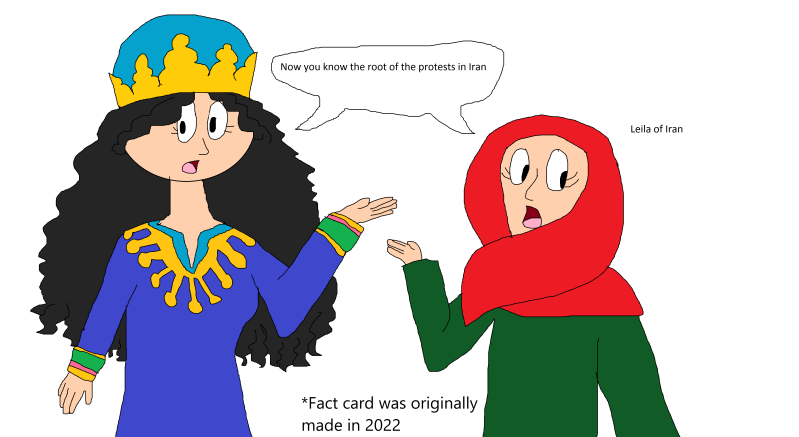
This fact card was created for Dictatober. Every October (or even a month or two after), we talk about dictators because nothing's scarier than having your human rights violated by a cruel head of state. Click this Jack-O-Lantern to see more Dictatober entries