

Impact of colonialism on Native Americans
Estimates of the population of native populations in what is today the USA were in the region of 5 million when Europeans arrived.
These were divided into 570 tribes across what we today call the United States.
Although with the same ethnic origin, each tribe had evolved its own custom, religion and language.
By the beginning of the 20th Century it was around 288,00. Today it is near 2.5 million.
How did this happen?
Initial impacts were generally co-operative across all contacts. There would be co-operation and trade.
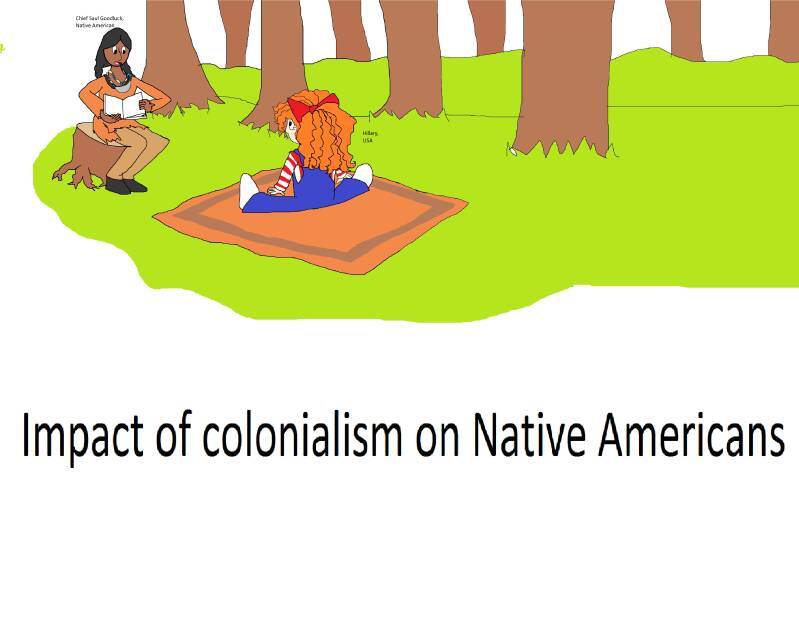
Thanksgiving day is a symbol of co-operation between both groups. The image created shows Pequot native Americans sharing their food with the Massacusetts colonists. In fact the natives went to visit the new arrivals with peace gifts. In fact this visit headed off a raid by the colonists on the Pequot camp. However a subsequent raid and the killing of 700 natives lead Masacussetts Governor to celebrate But whether it was beaver furs near the Arctic or buffalo in the Great Plains, it always ended with there being too many immigrants , all the resources being used up and Native Americans without anything to live on.
At this stage they were dependent on the kindness of Government for survival. There was little kindness in offical circles.
Government policy pushed them into reserves often thousand of miles from their homelands.
An unintended impact of the arrival of Europeans was disease. It is estimated that the arrival of European diseases notably smallpox, influenza, chicken pox and measles killed 80%-90% of native populations by the end of the 1700s. This was a huge disappointment to the colonists as they had planned to enslave the locals.
Native Americans were diverse and responded to settlers in different ways. Some like the Cherokee and Choctaw tried to find a place in the White mans' world. Others like the Plains tribes , Lakota and Cheyenne fought fiercely against encroaching intruders. The latter inflicted the biggest defeat in these wars at the Battle of Little Big Horn.
The result was always the same. Natives were outnumbered and outgunned.
They were victims of government policy that identified them as vermin to be exterminated and not peoples who had lived in the country for thousands of years, who deserved understanding. The attitude is best summed by the remark attributed to General Phil Sheridan : "The only good indian is a dead indian."
The native American religion was based on being one with nature and the environment. They never claimed ownership of land, but successfully extracted what they needed from their environment. Ancestors memories were kept on sacred sites.
This didn't match with the needs of farmers, miners and industrialists.
Land was signed over to the authorities in return for other poorer land and peace. But the discovery of minerals and further influx on settlers meant these treaties were simply torn up and the natives moved to smaller, even less productive settlements.
Their customs and traditions had to be sacrificed for survival. Christianity was imposed in school. The message was that native traditions were basically wrong and conformity to the white man's values was the only way ahead. Native languages were banned.
Today Native Americans are more confident in their rights and culture. They are more assertive in demanding their rights from the authorities. They are more willing to use media to celebrate their history and culture.
On the other hand Native Americans are one of the most disadvantaged groups in US society. Almost 50% still live on reservations. They are most likely to be unemployed. They are most likely to be without running water, sewage or a phone.