

Bela Lugosi
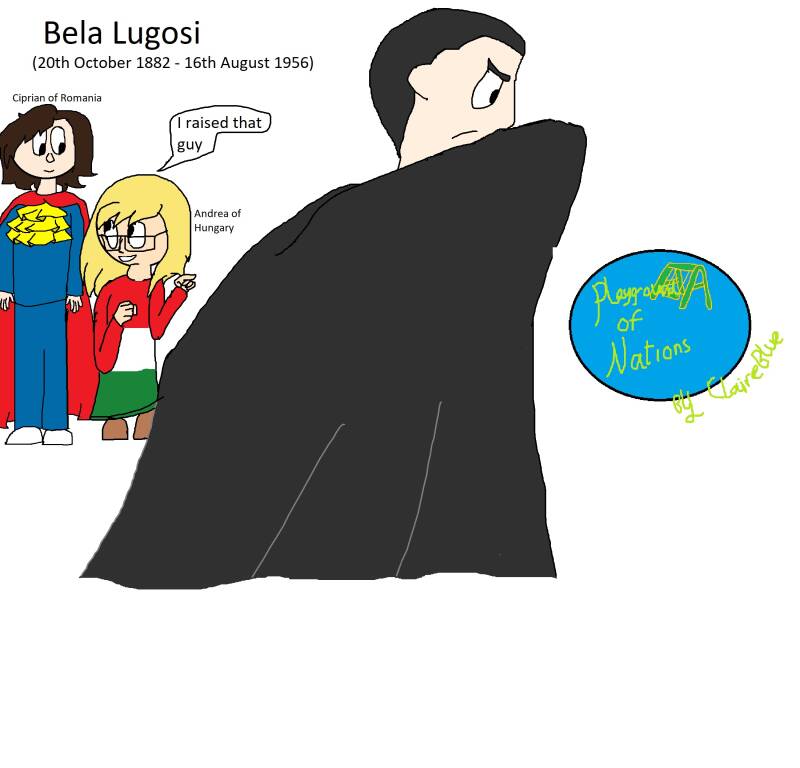
Bela Lugosi was born as Béla Blaskó the youngest of four children on 20th October 1882 to István Blaskó and his Serbian wife Paula de Vojnić at Bucegi Street, no 6 in Lugos when it was part of the Kingdom of Hungary. Today, it is now called Lugoj and is in Romania.
Some have said that he was coincidentally born within Transylvania but Lugoj as the town is now called is in the Timis County which is in the historical Banat region. That region borders Transylvania but it is not the exact same region. Either way, both the Banat region of the Transylvania regions were annexed by the Kingdom of Romania as part of post-WW1 border changes to Hungary in a political deal that Hungarian people didn’t get to vote in. By that time, Bela had already dropped out of of school at the age of 12 and left home to work at various jobs before playing a handful of small roles in Hungarian theatres as well as serving in World War 1 as an infantry officer. He was forced to flee Hungary when he started campaigning for better working conditions for actors during a revolution in 1919. He arrived in America in December 1920 on a boat and worked on merchant ships before acting on stage in New York. By then as well, he stopped going by Béla Blaskó and started going by Bela Lugosi with Lugosi being a nod to his hometown.
Bela first played Dracula in a play based on Irish writer Bram Stoker’s 1897 novel in the late 1920s. He had appeared in several pre-synchronised sound (AKA Silent) films made by American studios up to that point. The play was successful enough to run for 261 performances in New York before doing an equally successful nationwide tour between 1928 and 1929. While he wasn’t Universal Pictures’ first choice for the role of the Transylvanian vampire count, he did lobby for his desired role before winning the executives over courtesy of a paltry compensation of $3,500 for seven weeks of work. The film was a major hit when it was released in 1931 and Bela created such a sensation that he is said to have received more fan mail from women than actor Clark Gable. To drum up hype for his role as Dracula, the studio told the press a big fib about Bela’s dad being a count rather than the plain truth of him being a bank president. Interestingly, the film was released on 14 February 1931 (Valentine’s Day) which makes Bela Lugosi the first horror actor to be tied to two holidays, Valentine’s Day and Halloween (come on, it’s because of the horror films and vampire films he acted in).
However, the minimal use of makeup and the use of his natural Hungarian accent left him typecast as a horror villain. Hollywood only saw him as a horror villain and nothing else and that was frustrating for him because he liked to act and wanted to make more money in the film industry as an actor and he wanted to play more than just the horror villain role. It didn’t help that there was another horror actor making the rounds in Hollywood, an English man named Boris Karloff who would later narrate an animated adaption of Dr Seuss’ How the Grinch Stole Christmas in 1966. Karloff became famous for his portrayal of Frankenstein’s monster in Universal’s 1931 adaption of the 1818 Mary Shelley novel Frankenstein. Lugosi and Karloff would act in several films together during the 1930s and 1940s like 1939’s Son of Frankenstein where Bela played Ygor while Basil Rathbone (who is famous for playing Sherlock Holmes) played the son of Dr. Frankenstein. While both had their names on the film posters (called billing) Karloff always got top billing and yet they never hated each other at all despite always competing for the same roles. They were amicable but almost had no relationship off set.
As Bela got older, the injuries he sustained during World War 1 came back to haunt him and he ended up trying various remedies to lessen his suffering. He still struggled with film work but thrived on the stage as he had before. Eventually, a new generation of directors came and they wanted Bela to be in their films and of course, Bela did appear in these to the best of his abilities.
When Bela died on 16 August 1956 of a heart attack while having a nap at the age of 73, he was not clutching the script of a planned Ed Wood film. That was another fib told about him. He was in a dire financial situation when he died but his funeral was also not paid by famous crooner Frank Sinatra but rather his widow Hope and his ex-wife Lilian did and while they buried him on one of his Dracula capes, it wasn’t one from his role as Dracula from the film that made him famous as that is now on display at the Academy Museum of Motion Pictures after his son owned it for many years. Boris Karloff wasn’t even in California at the time of Bela’s funeral so he didn’t get to see him being lowered into his grave at the Catholic Holy Cross Cemetery in Culver City, California. That cemetery is also where Jack Haley who played the Tin Man in the 1939 Wizard of Oz film is also buried as well as Bing Crosby (known for his rendition of the Christmas song White Christmas) and another Wizard of Oz actor Ray Bolger, the actor who played the Scarecrow.
For a long time, Bela’s native Hungary was unaware of their famous son’s filmography and Hungarian critics and viewers actually slammed Dracula (1931) when it was released there and it was only with the collapse of a Nazi puppet state and a communist dictatorship as well as the rise of the internet was when Bela’s works started gaining attraction in Hungary. Vajdahunyad Castle in Budapest, Hungary has a bust of Bela Lugosi.