

Mikhail Gorbachev
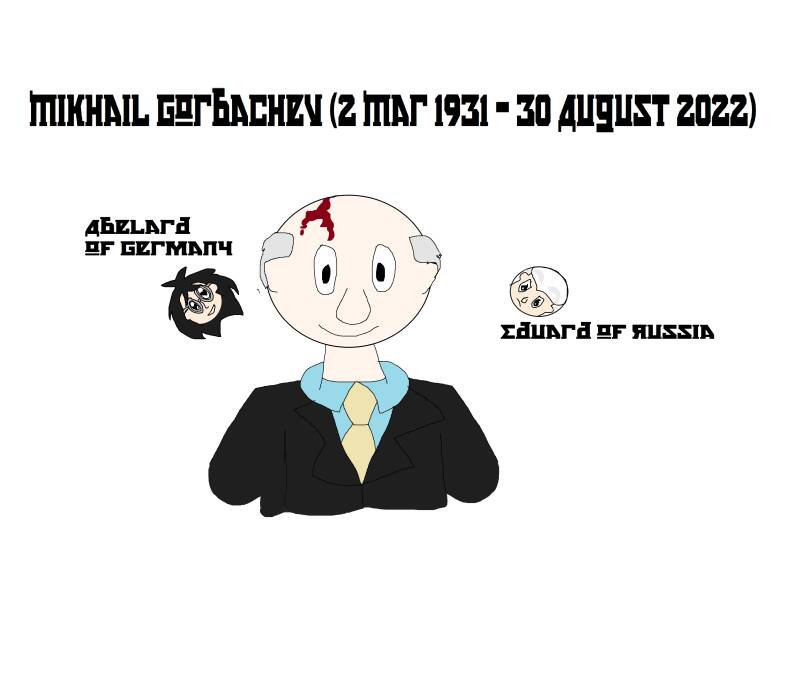
Born in 1931, Mikhail Sergeevich Gorbachev was raised in the small Russian village of Privolnoe, which is located in the Stavropol region. Initially intended to be called Viktor, the infant was secretly baptized Mikhail while his relatives saw his port wine stain birthmark as a bad omen. For many generations, his family had been a rural one. During the enormous agricultural collectivization, Gorbachev's relatives suffered persecution; one of his grandfathers, a rural official, was jailed, while the other was temporarily banished
He had a difficult upbringing on the new kolkhoz, particularly during the Nazi occupation in 1942-1943; his recollections of his early years are not emotional at all-"mud huts, earthen floor, no beds"-but he made it through. Like the other young people from the village, Gorbachev toiled in the fields both during and after the war, and in 1949 his hard work was recognized with the order of the red banner of labour. Due to his exceptional academic performance in the local school, he was awarded a silver medal for intelligence and was admitted to the Julius Prudence faculty at Moscow State University. He also joined the Komosol (Young Communist League) in 1946. It was at Moscow State University was where he met the woman that would become his wife Raisa Gorbachev, with whom he father one child, a daughter.
Following graduation, Gorbachev headed the local Komsomol in his native Stavropol province. By using charm to win over powerful politicians, he was able to advance to the position of First Secretary of Stavropol in 1970, which gave him considerable authority over the area.
From then, he had no trouble joining the political elite of Moscow. Gorbachev was appointed Secretary of the Central Committee in 1978. With the promotion came a significant rise in his standard of living; he and his wife, Raisa, now had better access to shopping, healthcare, and even a cook and maids. The move to Moscow was a partial realization of his original dream of becoming a lawyer which was crushed when new rules introduced at the time of his graduation prevented him from working for the USSR Procuracy in Moscow.
He was young and energetic in comparison to his old and frail colleagues who died in quick succession. Gorby was in his early 50s when his predecessor, Andropov died and he became the new leader of the USSR. Not long after obtaining this position, he began to set out for new economic reforms and then later on freedom of press. This was glasnost (openness) and Perestroika (Restructuring). Glasnost (openness) saw censorship relaxations and freeing of the press. Big Brother was no longer watching them. The public could now vent about the problems about the system without losing their freedom. Glasnost allowed a person to talk about their problems with the system and be given possible solutions. Glasnost (openness) saw censorship relaxations and freeing of the press. Big Brother was no longer watching them. The public could now vent about the problems about the system without losing their freedom. Glasnost allowed a person to talk about their problems with the system and be given possible solutions.
Perestroika (Restructuring) saw the economy and the politics of the Soviet Union being reformed. At that time, the Soviet Union was spending their funds on the soldiers in Afghanistan and left the civilians in a neglected state. The supply chain was worse than the post Suez Canal blockage of 2021! With perestroika, the supply chains improved and the economy was decentralised. No more standing in a long line for a loaf of bread! Perestroika also saw the westernization of the Soviet Union which meant that Levis and McDonalds opened up branches in the Soviet Union. Sadly because of Putin getting involved in a war in Ukraine by illegally invading it, those brands are since left Russia. To quote BBC Russian Editor Steve Rosenberg, Mikhail Gorbachev was the kind of Russian leader the world had never seen as he smiled and he was relaxed. To further quote him, he gained almost pop star status for helping to end the cold war. At the end of the BBC News obituary he made on Gorbachev, Rosenberg told viewers that he will remember him for being invited to play one of his late wife's song which Gorby sang following an interview.
However despite the liberation that was going on in Eastern Europe thanks to Gorby's reforms, the people in the USSR were not happy. There were some in countries that were part of the USSR at the time like Latvia who wanted to break away and eventually did and then there were those who wanted to go back to the olden days before Gorbachev was in power and these conservative Russians had a coup staged though this coup failed. However the price of this coup was the existence of the Soviet Union as many countries broke away not long after. The last rites for the USSR was not given by a priest but rather by Gorbachev who did it through his resignation speech that was televised on 25 December 1991 and the next day, the USSR was consigned to history, leaving 15 independent countries to inherit its dodgy legacy.
The last 30 years of his life was spent watching Russian's democracy phase become a return to isolation further exasperated by the rise of Vladimir Putin and his toadies while initially supporting Putin, Gorby later turned to criticizing him, especially during the start of the Ukraine War political tensions having Returned Gorbachev shall be at least remembered for trying to bring peace to east and West and stopping the rivalry between the two, even if he was shunned by the older gen following the fall of the USSR. Gorbachev also wrote at least 24 books with the latest one being The New Russia which was released in 2015. Anyone who teaches Russian history or studies Russian history or happens to have a fascination with Russian history like the author of this fact card may have some of these books if not at least one on their bookshelves.
Having outlived his wife in 1999 Gorbachev was buried next to his wife Raisa in Novodevichy cemetery and Moscow in early September just a few days after he died on 30th August 2022.