

Fidel Castro
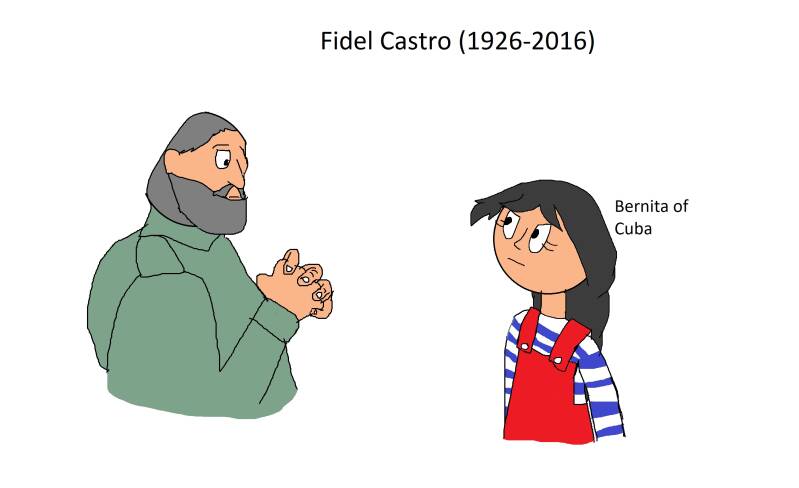
Fidel Castro was born the son of a Spanish landowner in 1926 in Cuba. As a student in the 1940s, he became involved in revolutionary politics. This developed into involvement in the overthrow of capitalist dictators in the Dominican Republic and Colombia. In 1953 he began a liberation movement in Cuba. This was defeated and he was jailed until 1955.
Once released he went to Mexico where he met a young Argentinian revolutionary, Che Guevara and founded a new Cuban revolutionary movement to overthrow the then dictator, Batista. On his return to Cuba in 1956, Castro, his brother Fidel and Guevara were met by just 19 supporters. In spite of constant pressure from the military, Castro won the support of the poor of Cuba and overthrew the forces of Batista in 1959.
Castro set up a Government of the People, but controlled by Castro. Firstly he settled scores with opponents from the previous government and the military.(an estimate of between 1,000 and 4,000 were executed. Secondly he attempted to consolidate relations with the US. But Americans had lost considerable investments in Cuba and thousands of Cubans had escaped from Castro's regime to the US. The Americans implemented an embargo on imports and exports with Cuba that has crippled its economy. In its place Cuba became dependent on left leaning regime's especially the Soviet Union.
At home, Castro implemented a Socialist form of government. Land was redistributed among the poor. Tourism was nationalised as was the sugar industry. Salaries among managers, the professional classes and the middle class in general were all reduced. This led to a brain drain as these groups migrated to Florida. Meanwhile salaries among the less well-off were raised. Investment was made in transport infrastructure, education and health. There was an emphasis on the development of media, but this was largely for propaganda. Although progressive in many of his policies, Castro maintained control by the use of secret police, informers, imprisonment without trial and ill-treatment for those in prison
In 1961, a military attack manned by Cuban emigrants and sponsored by the US attacked Cuba at the Bay of Pigs. Castro's forces were victorious. This drove him even more into the hands of the Soviets. In 1962, Cuba permitted the installation of Soviet nuclear missiles on their territory aimed at the US. This was a step too far for the Americans. With the danger of a Third World War, the Soviets were forced to withdraw.
So Castro found himself in charge of a country socially progressive, an icon of revolution for states in the developing world. At the same time economically strangled by the US embargo and dependent on the Soviets for economic survival. So Castro was a supporter of Allende in Chile and the Sandinistas in Nicaragua. He supported the Soviet's oppression of the Czechs in 1968. In 1970s and 1980s Cuba supplied troops to assist left leaning leaders in Angola, Mozambique and Ethiopia. In 1985, President Gorbachev was elected president of the Soviet Union. He wanted to ease out of the Cold War and develop the Soviet Union. He ended the subsidies to Cuba. This led to a 40% decrease in the economy. Castro had to reform his economy. He diversified into tourism and biotechnology. He sought new allies among other left leaning Latin American countries. This helped revitalise the economy.
In 2006 following a period of illness, Fidel Castro handed power over to his brother, Raul. In 2008 he retired completely. Fidel Castro died of natural causes in 2016.
This fact card was created for Dictatober. Every October (or even a month or two after), we talk about dictators because nothing's scarier than having your human rights violated by a cruel head of state. Click this Jack-O-Lantern to see more Dictatober entries