

Queen Mary I of England
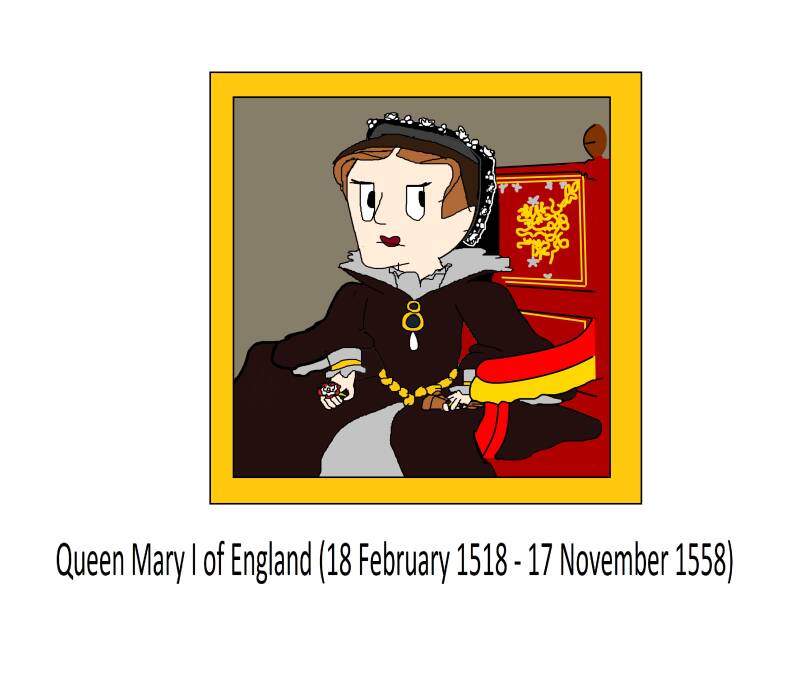
Born after her Spanish mother Catherine of Aragon experienced four losses that were either miscarriages or stillbirths as well as the sudden mysterious death of a son named Henry, the Tudor princess Mary was born in Greenwich, England on 18 February 1516. Her father King Henry the Eighth thought that girls were too silly and too emotional to rule and yet he ended up setting up the Church of England so he could divorce from Catherine as well as annul (making the marriage non-existent in the first place) which temporarily saw Mary illegitimate. Annul is a such a dull word to rhyme with anything so that’s why we’re taught the rhyme divorced, behead, died, divorce, beheaded, survived when it comes to Henry the Eighth's wives. Henry’s next marriage saw Mary end up with a half-sister named Elizabeth. When Elizabeth’s mother Anne Boelyn was beheaded, Henry married Jane Seymour and she gave him a son named Edward. Honestly, Henry was too emotional and too silly to rule if he says something sexist about women one minute before pitching the tantrum of the century for a male heir and causing a split in the Church the next.
Eventually, Henry made Mary along with her stepsister his legitimate heirs again and it was just in time as his jousting accident triggered habits ended up seeing him kick the bucket at the age of 55 in January 1547 and that saw his son Edward become king at the tender age of 9-years-old. However, Edward was a sickly little lad, and he died at the equally tender age of 16-years-old in 1553. Mary knew that she was next but then she found out about a girl named Lady Jane Grey who was made the heir of her dearly departed brother. Mary didn’t like that and she ended up storming to London and overthrowing Lady Jane Grey. Jane was beheaded not long after her nine-day reign.
Now that she was officially queen (in fact, the first queen to rule England), she decided that the country was to become a Catholic country again and that saw Protestants being violently prosecuted and in the year 1555, she had 3 Protestant bishops in Oxford being burned. She earned the name Bloody Mary as a result and some folk think that the children’s nursery rhymes Three Blind Mice and Mary, Mary, Quite Contrary are sweetened retellings of her sectarianism (discrimination against someone for their beliefs). Three Blind Mice ties back to the Protestant bishops’ deaths and Mary, Mary Quite Contrary was about her disturbing and squeamish ways of torturing protestants.
In 1556, Queen Mary I (the first) had her country’s men with their families in tow plant new towns in what are now the Irish counties of Laois and Offaly. These two counties were quickly renamed to Queen’s County and King’s County (after Mary’s new Spanish husband Philip the Second of Spain). The native Irish clans of O’Mores and O’Connors were sent running to the hills with their lands being stolen by the English who set up Maryborough in Queen’s County and Phillipstown in King’s County. These towns are now called Portlaoise (hometown of actor Robert Sheehan) and Daingean and while both towns were built around forts to keep the Irish clans out, only Portlaoise’s fort still stands. The Laois-Offaly planation was a failure as there weren’t enough English settlers being sent over to Ireland and the bulk of the plantation’s budget was spent on protecting the settlers from the O’Mores and the O’Connors. This plantation and plantations that followed this one in Ireland would not only affect Irish society and politics but also would go on to be the basis for English plantations in North America like the 13 colonies that would later become part of the United States of America.
Queen Mary I’s personal life was also failing too as her husband Philip (the namesake of The Philippines) deserted her, and she had many instances where she thought she was pregnant, but it turned out that she wasn’t pregnant at all. In fact, the time she thought that she was pregnant with a son was actually the start of a disease that ended up killing her on 17 November 1558. Her stepsister Elizabeth became Queen Elizabeth I and she returned England to the protestant faith and kept rejecting her former brother-in-law's marriage proposals. While Queen Mary I wished to be buried with her mother at Peterborough Cathedral in Peterborough, England, she ended up being buried at Westminster Abbey in London, England where she now shares the grave with her sister’s whose celibacy ended the Tudor lineage.