

Leopoldo Galtieri
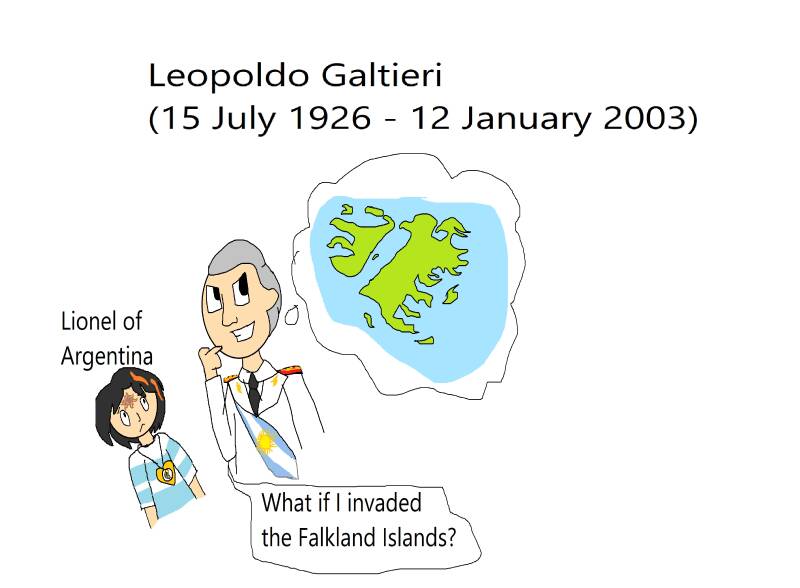
Leopoldo Galtieri was born outside Buenos Aires in 1926 to a working class family.
In order to pursue his interest in engineering, he entered the Military Academy to study civil engineering. He balanced his study of engineering with his study of military affairs.
In 1949 graduated from the US Army School of the Americas (US). In 1958 he became a professor of engineering. He continued his steady progression in engineering and the army for the next 25 years.
In 1976 he supported the military junta's coup, overthrowing Isabel Peron's regime. The right wing regime set about about moving the country in a right wing journey. They received active support from the US, who saw them as a bulwark against Communism. This was achieved by banning all political parties, political activies and extermination of left wing supporters. In what became known as the "Dirty War", the number is estimated to be between 9,000 and 30,000 disappeared. Torture and mass executions were commonplace. He also was a strong supporter of the Nicaraguan Contra movement. The junta's main rationale for its coup was the state of the Argentina's economy.
With heavy initial foreign investment, the economy made initial progress. However the underlying problems persisted and the situation deteriorated.
In December 1981 Galtieri succeeded Roberto Viola as President of Argentina. Viola resigned under pressure from his failed economic policies.Galtieri wanted to put his own mark on the presidency.
He brought in political reforms to allow some dissent. He brought in some economic reforms.
To galvanise nationalist spirit within the country, he decided to occupy the nearby Falkland Islands from Britain. He calculated that Britain had enough domestic problems to make a war in a far distant group of tiny islands.
Of course he was wrong. Britain's leader was also going through economic crisis of its own. She (Margaret Thatcher) needed a galvanising, nationalist event of her own.
Defeat to Britain was the last straw for the regime. The list of disappeared, civil rights valuations, economic crises, the failed war all combined to galvanise the Argentinian people to overthrow the generals.
As head of state, Gailtieri took the brunt of public hate. When a democratic government was reinstalled, the new president, Menem, gave the generals amnesty. This is because there was there was still a fear of the military. So Galtieri spent his latter days living modestly with his wife in Buenos Aires. In 2002 new charges were brought against him.
However he died in 2003 before the trial could begin.