

The Unusual History of Co-Ordinates
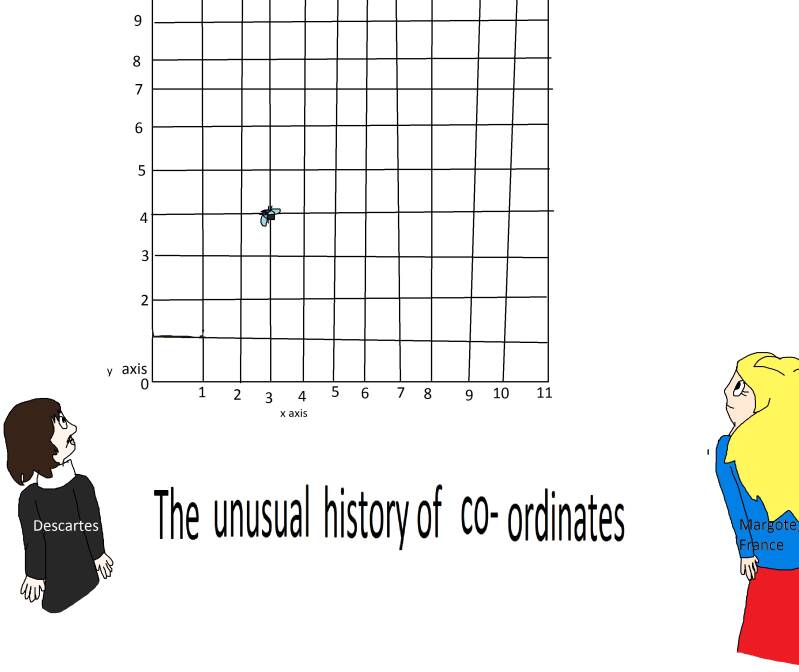
One night in 17th century France, a mathematician named Rene Descartes was lying in his bed until late like what he had been doing usually before bed when he caught sight of a fly who was on the bedroom ceiling. Descartes wondered what would be the best way to describe the fly's location and decided to use one corner of his ceiling as a reference point.
With a rectangle drawn on a piece of paper, the bottom left corner is used as a reference point. With that you can specify the location of the fly by measuring how far one would need to go vertically and horizontally. Each coordinate pair specifies a unique point on Descartes' ceiling and every point on his ceiling come with a unique pair of coordinates. The idea can be extended which allows the axes (two sides of Descartes' room) to become infinitely long in both directions and the bottom part of the vertical axis and horizontal axis are labelled with negative numbers therefore, one can specify all points on an infinite axis.
The coordinate system Descartes developed, which was later called the Cartesian system after himself, created a link between algebra and geometry and it allowed for geometric shapes like circles to be described algebraically using coordinates of the pints that make up that shape. Descartes also came up with the line "I think, therefore I am" which you may have heard of before.