

Australian Penal Colonies
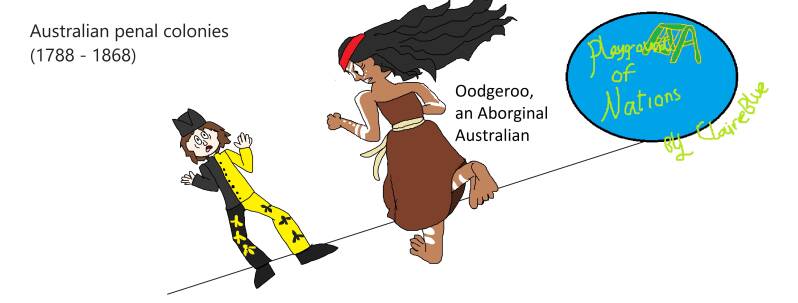
For a while, Colonial America was a destination for whose who committed crimes in Britain but when the 13 British colonies broke free to become the first 13 states of the United States of America, Britain was forced to think of a new location for its convicts to keep them out of British society. During that interim period, criminals were imprisoned domestically in Britain during hard labour in prisons or in chains from Moor prison ships known as hulks. Issues with overcrowded prisons led to Britain considering Australia as the new destination to ship its convicts off to. There they would establish New South Wales as a penal colony on land that was colonised and claimed for Britain in 1770. Along these lines, the whole continent would be colonised.
So what crimes could someone commit that would’ve seen them being shipped off down under?
Pickpocketing, pinching a handkerchief, stealing goods values at five shillings or more, burglary, forging and rioting. One Aussie on Reddit said that their ancestor called a lord in the British Parliament a foul word that was preceded by mangy. Offenders had two choices: exile to a penal colony or being executed.
The first fleet arrived at Botany Bay, New South Wales, Australia on 20th January 1788 with over 700 convicts as well as their families and over 500 marines and officers on board. This was followed by the establishment of the Port Jackson penal colony at Sydney Cove (known by its Aboriginal name as Warrane) followed by further penal colonies being established across Australia in the 19th century.
Upon their arrival, convicts were separated and sorted by the governor into gangs based on their skills. A skilled convict like a carpenter, blacksmith or a stonemason could be used for government work projects such as building roads, bridges, courthouses, hospitals or working on government farms. An unskilled convict however was usually given labouring work like gathering and burning seashells to create lime mortar or breaking rocks into gravel for the construction projects.
Free settlers where those who came to Australia on their own terms and not because they were sent there for committing a crime and convicts who had done their time for the crime also picked such convicts they wanted to work for them as servants. 15% of the convict population was made by women and their usual profession was as domestic servants to the officers or working the women-centric factories where they did hard labour at the wash tubs or made clothes. As male free settlers were often looking for a wife, many women married quickly.
Initially, convicts wore their own clothes but that changed with the arrival of more free settlers and it became necessary to distinguish free settlers from convicts and that saw the introduction of a yellow and black uniform that resembled the bizarre costumes worn by Medieval court jesters. These uniforms with their arrows that identified them as government property was design to humiliate the convicts.
The military guards harshly enforced discipline and punishments included flogging, heavy ankle irons/ chains or the treadmill as well as dark dull cells as part of a different kind of punishment called solitary confinement. These punishments were given out for any lazy prisoners or prisoners who were rebellious on the job. Should a convict continue to act up, and cause problems then they were sent to penal colonies or prisons that were more remote like Norfolk Island, Port Macquarire and Moreton Bay. It was different for the women as their punishments included having their heads shaved or placed in solitary confinement.
So what if a convict escaped? Well, they had to face the Australian continent’s wilderness with starvation acting as a deterrent if deadly funnel web spiders weren’t already a deterrent. Of course, much like a lot of places colonised by a European nation, Australia wasn’t devoid of pre-colonial society so the white convicts had to face the dark skinned Aboriginal people who were unamused to find that their home of 60,000 years have been overtaken by white colonisers and as a result, fights would break out.
What happened when a convict had done their time in Australia? Prison time for a convict during this part of Australian history ranged from seven years to life. If a convict had worked hard, they could obtain a ticket of leave or a pardon. These were frequently granted to a convict after 4 years for those with sentences of 7 years. A ticket of leave meant they they could work for themselves at a known property. As for a pardon, there were different types and they determined whether they were allowed to stay in Australia or travel anywhere in the world if they could afford to do so as only a few convicts could actually afford the transportation back to rainy England.
From 1788 to 1868, an estimated 165,000 convicts were transported to various penal colonies in Australia by the British government.
Interestingly for a country that started out as a penal colony, Australia nowadays deports foreign criminals on top secret charters run by the Australian Border Force. These planes are only marked with the Australian flag on the plane’s tail and usually carry the worst of the worst criminals who came to Australia with a clean criminal record which then got filled up during their stay. You harmed a kid in the most horrible of ways or even behaved inappropriately towards them? You’re out! You became part of a motorcycle gang that did illegal activities? You’re out! You murdered people? You’re out! Foreign criminals would have their visas destroyed after conviction and once they have served time in Australia, they are marched onto the plane. The Australian Border Force secret deportation charters go all around the world, including to the United Kingdom. The convicted criminals being deported helps with protecting the Australian communities from serious dangers. 9 News Australia got an exclusive insight to one flight that deported criminals back to New Zealand back in early 2021.