

Battle of Thermopylae
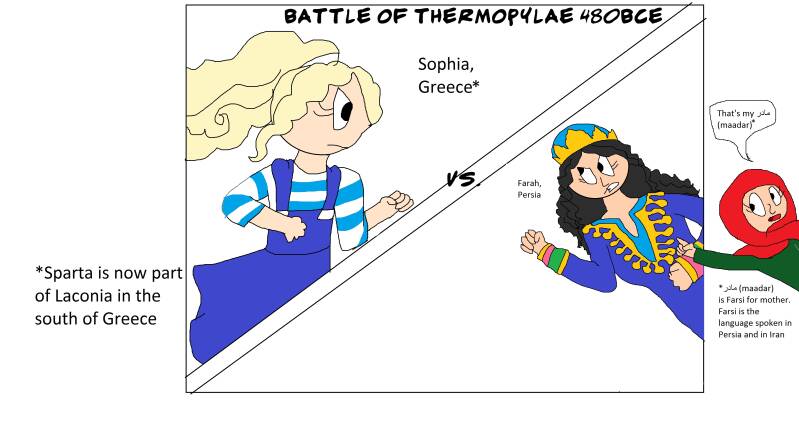
One of the great stories of Ancient Greece is the story of how 300 Spartan soldiers held off a huge Persian army at the pass of Thermopylae in 480 BC. While some of the stories are a little exaggerated, it is based on facts.
At that time the Persian Empire was the largest in the world stretching from Afghanistan to modern Turkey and from the Arabian Sea to southern Russia.
It had massive political power. In 490 BC the Persian army had been defeated by the Athenian army at the battle of Marathon. In 480BC they returned better prepared.
Greece was a mess. It was divided among warring city states. The strongest of these were Athens and Sparta. In order to stand up to the mighty Persian army, the different city states had to delay the invasion and unite against the Persians.
Sparta was a special case among Greek city states. The culture was built around war and loyalty to the state. Boys left their homes at 7 and enrolled in a cruel regime to turn them into fearless, disciplined warriors by their late teens. Women were educated in the warrior culture but didn't participate. Most of the essential work was done by slaves.
The battle took place at a narrow mountain pass in northern Greece, where 7,000 Greeks from various Greek cities tried to block the Persian army. The leader was Leonidas a Spartan. (First myth busted it wasn't just 300 Spartans.)
The Persian army was said to be over a million, but that may have been an exaggeration. There were a lot of them.
Had the 2 armies met on an open plane, the Greeks would have been quickly overrun. But a narrow rocky pass meant that the Persians had to defeat a small number of Greeks at a time in hand-to-hand combat. This suited the Greeks. The Greeks used metal helmets, large shields and long spears. They formed tight formations called a phalanx. The Persians didn't wear metal armour and only had wooden shields . Attacking the Greeks was like attacking a porcupine. They just couldn't get near them. When they charged at the phalanx, they suffered massive losses. Their arrow fire had little effect against the shield wall.
Meanwhile Sparta did not stand alone as the legend suggests. Xerxes had an enormous fleet which could have landed behind the Spartans and attacked them from the rear. But the Athenian navy defeated the Persian fleet at Artemisium.
The battle at Thermopylae lasted three days. On the first two days the Persians suffered huge losses and the Greek phalanx held firm.
On the third day Xerxes had learned that there was a mountain pass that allowed his army attack the Greeks from the rear. Leonidas had placed Phocian troops to guard the pass. But the Phocians had gone home to protect their own city.
When he heard that the Persians were about to surround his troops, Leonidas had a tough decision to make. To stay was certain death. He allowed his allies to leave, although some (about 2,000) insisted on staying. When the Persians attacked, the Greeks were surrounded. They continued to fight bravely until they had all been killed.
Xerxes continued his invasion until his defeat at the Battle of Salamis. While he tried a later invasion, circumstances had changed. The Greeks were now united to fight a common cause. The Battle of Thermopylae became a legend both of human bravery, Greek nationalism and the fighting spirit of the Greeks.