

Pol Pot
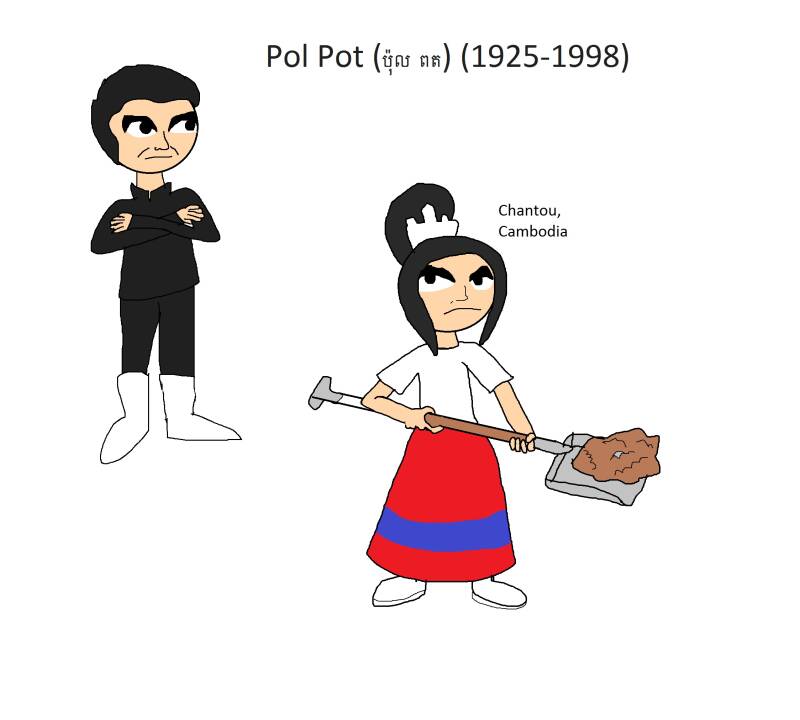
At one point Cambodia, a country in South East Asia had 9 million people but that number went down to 7 million because of Pol Pot, a man who joined the proto communist Khmer People's Revolutionary Party (KPRP) in the 1950s and rose party chief ad oversaw the takeover of Cambodia in a national uprising in 1968. The word Khmer came from the Pali term khmerara (one who is wholesome).
under the Khmer Rouge which lasted for 4 short years, private property was government property, jewelry, being religious and gambling was not allowed, doctors and civil servants (basically anyone very intelligent) were considered dangerous and were detained or murdered.
People were spending their time vastly working for the government and barely had enough food to live with. High schools and other public places were turned into detention centers. With the schools closed, everyone was forced out of the urban areas and into rural areas to work on the farms. The country had become an agrarian society practically overnight by the Khmer soldiers with the importance and purity of farming and rural life being emphasized above everything else. With school done (teachers were murdered and school buildings turned into detention centers), the only thing the Khmer Rouge wanted to teach was farming and obedience.
Pol Pot also changed the social order entirely by making four new categories of people in order to class his new population of worker slaves.
If you were aligned with Western values or had happened to live in the city, you were the new people and had almost no or little rights than most.
If you were loyal to the Khmer Rouge, you maybe moved up to deportee status.
If you really x2 behaved yourself then you may eventually be considered candidates for full citizenship.
Finally, if you really were a good little government stooge, you may be rewarded with a full rights citizen status.
Yet, many people stayed at the status the Khmer Rouge put them into when they first classified them and it was extremely rare for them to move up and this was because the entirely new hierarchy was meant to glorify and elevate an existing of people over others, and systems designed to glorify and elevate an existing category of people over others, and systems designed to discriminate and not be fair. The Khmer Rouge forcibly separated families entirely to better brainwash the populace which even many of the world's worst dictators in history would thought was cruel even by their standards. When Cambodians living in the city were forced out into the countryside to become worker drudges, the Khmer Rouge separated families en masse. While many dictatorships would done such things in order to punish others for subversion, Pol Pot did it as a calculated move to make his regime into the perfectly well oiled machine. Why did he do this?
1. It made it a lot easier when he removed the family unit with the government becoming the family authority that raised the children.
2. Pol Pot also wanted to organise people based on their skills and uses as efficiently as possible and that meant grouping children with other like children, women with women and so on and so forth.
3. This also meant sending people away to areas where he felt they would make the most sense as workers. Therefore it was a natural byproduct of his policies even regardless of brainwashing reasons.
If the Some are more equal line from Animal Farm by George Orwell is truthful then it is fitting with the Khmer Rouge. Pol Pot essentially made the whole thing a battle and is responsible for the deaths of over 2 million people in places called Killing Fields. His Cambodia was an attempt at rapid social engineering and he alarmed many Communist countries with his rule at the time which came crashing down with the Vietnamese invasion of Cambodia in 1978-1979 which lasted for 10 years. After being deposed, Pol Pot fled to the jungle where he resumed guerrilla operations. He died on 15 April 1998 of heart failure while under house arrest, 5 years after Cambodia's monarchy was restored. A bust of him which was made in anticipation for an unrealised cult of personality is on display in the Tuol Sleng Genocide Museum in Phnom Penh, Cambodia.