

Mobutu Sese Seko
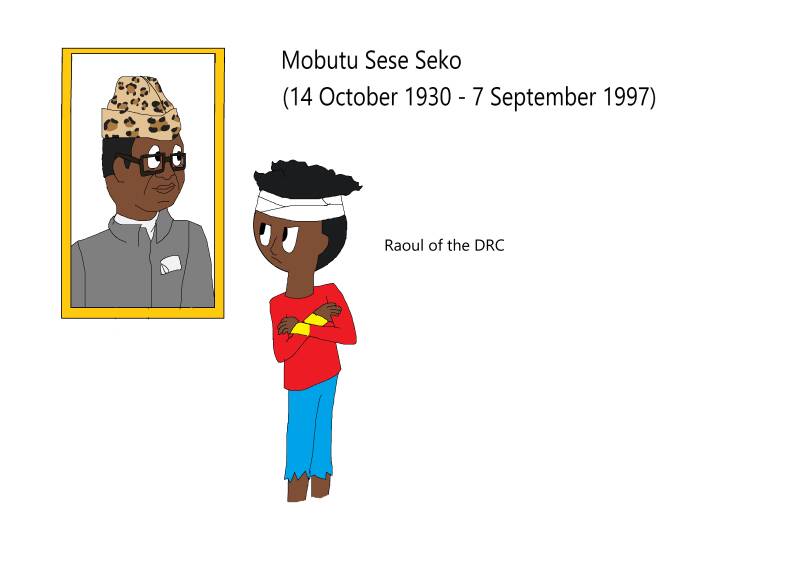
Sese Seko Mobutu was born in Northern Congo(then a Belgian province) in 1930.
In 1949 he joined the army in 1949 where he received both an education and contact with the principal figures of the independence movement. Following independence in 1960 the wealthy Kinshasa and Kasai regions attempted to declare independence. This ultimately led to a civil war and the murder of the elected president Patrice Lumumba.
As the leader of one of the few stable forces in the fledgling republic, the army, Mobutu seized power by coup d'etat in 1965. Mobutu ruled the country which he renamed Zaire with an iron rod. His rule was controlled through his Popular Movement of the Revolution Party (MPR), which ensured his policies were followed and shared in his corruption.
He brought certain clear principles to his rule.
1. African identity - he encouraged the use of African names in the state.
2. Brutality -- he enforced his control using the strength of the military.
• Opposition was met by summary arrest, torture and murder
• Criticism of the regime was a suicidal option.
• The only media permitted was tightly controlled.
3. Corruption - all business was controlled by government and the right to do business had to be paid to Mobutu and his Party members. Favours were done for family members or for payment.
The favoured received jobs irrespective of their ability to do them. The country suffered and stagnated as a result.
4. Extravagance - Mobutu liked to have ostentation. The form of government (called Kleptocracy or government by thieves) created wealth for him estimated between USD 4 to USD 15 Billion. This was from a country with one of the lowest standards of living in the world. Meanwhile Mobutu did his shopping in Paris by supersonic jet.
5. Mohammad Ali - in 1974 he hosted the World Heavyweight Boxing title match between Mohammad Ali and George Foreman, entitled the Rumble in the Jungle. Zaire was the first African country to do this.
6. Life for the ordinary people - the Rumble in the Jungle was typical of Mobutu. It was expensive and reflected Mobutu's ego. Meanwhile daily life was miserable for the ordinary citizens. The police state controlled every part of daily life. Government services such as police, healthcare and education ceased to exist. Mobutu had maintained his position by declaring himself an ally of the West and an enemy of Communism. When the Civil War in Angola and Black power returned to South Africa, his importance to the West diminished.
Following Rwandan genocide in 1994. large groups of Hutu and Tutsi refugess escaped to Zaire. When the Tutsi Liberation army followed the Hutus into Zaire. This destabilised Mobutu's regime. Opposition forces within Zaire allied themselves with the Tutsi army. Mobutu was overthrown. He fled to Morocco where he died in 1997.