

Michaelangelo's the Pieta
Before his name was used for a tall, orange clad, mutated fighting turtle, Michelangelo was only 6 years old when his family moved to Florence where he would grow up during the Italian Renaissance which would inspire him to become an artist. He worked with Ghirlandaio as well as the Medici family, sculpting and painting. His works include David, the Sistine Chapel, Madonna of the Steps and the Last Judgement.
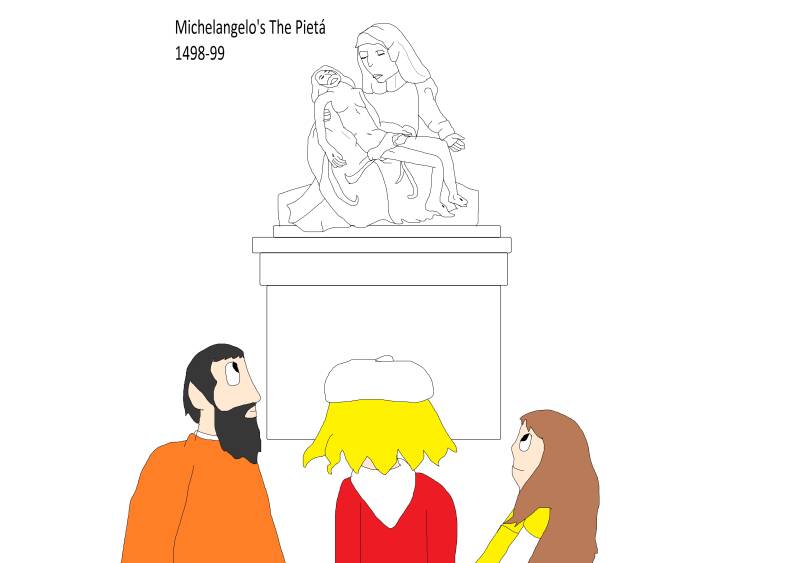
In 1496, he was commissioned by Jean de Bilheres, a French-Roman cardinal to sculpt the Pietá for his funeral monument. Pietá is a Latin word, meaning pity and depicts the Virgin Mary holding the mortal remains of her son Jesus Christ after his crucifixion by Roman governor Pontius Pilate. The statue was sculpted in white marble from Carrara quarry and sculpted an oversized Mary cradling Christ in her arms. The statue features a mash up of sculpting styles as Michelangelo has been praised for marrying poses that favoured naturalism with Renaissance ideals. The figure from Mary's head to the bottoms of her robes resemble a pyramid. When it was finished in 1499, it was on display in the Chapel of Santa Petronilla but can be found today in St Peter's Basillica in the Vatican.
Michelangelo lived for 88 and 3/4 years, dying in Rome in 1564, his last work being the Rondanini Pietà, another post crucifixion sculpture in marble.